## Number of FIR coefficients (including the zeroth one)
n <- 20

## Rule-of-thumb frequency discretization (Cheney's Approx. Theory book)
m <- 15 * n
w <- seq(0, pi, length.out = m)

## Construct the desired filter: fractional delay
D <- 8.25              # Delay value
Hdes <- exp(-1i * D * w) # Desired frequency responseChebyshev Design of an FIR Filter
Introduction
This example is adapted from the CVX example of the same name, by Almir Mutapcic (2/2/2006) and the CVXPY adaptation by Judson Wilson (5/27/2014).
This program designs an FIR filter, given a desired frequency response \(H_{\mathrm{des}}(\omega)\). The design is judged by the maximum absolute error (Chebyshev norm). This is a convex problem (after sampling it can be formulated as an SOCP), which may be written in the form:
\[ \begin{array}{ll} \mbox{minimize} & \max |H(\omega) - H_{\mathrm{des}}(\omega)| \quad \text{for } 0 \leq \omega \leq \pi, \end{array} \]
where the variable \(H\) is the frequency response function, corresponding to an impulse response \(h\).
Topic reference: “Filter design” lecture notes (EE364) by S. Boyd.
Problem Data
Solve the Minimax (Chebyshev) Design Problem
The frequency response from a vector of filter coefficients \(h\) is computed as \(H(\omega) = \sum_{k=0}^{n-1} h_k e^{-j k \omega}\), which can be expressed in matrix form as \(H = A h\) where \(A_{\omega,k} = e^{-j k \omega}\).
Since CVXR works with real-valued math, we split the problem into real and imaginary parts. The objective becomes:
\[ \mbox{minimize} \quad \max_\omega \left[ (\mathrm{Re}(A) h - \mathrm{Re}(H_{\mathrm{des}}))^2 + (\mathrm{Im}(A) h - \mathrm{Im}(H_{\mathrm{des}}))^2 \right]. \]
## A is the matrix used to compute the frequency response
## A[w,:] = [1, exp(-j*w), exp(-j*2*w), ..., exp(-j*(n-1)*w)]
A <- exp(-1i * outer(w, 0:(n-1)))

## Split into real and imaginary parts
Hdes_r <- Re(Hdes)
Hdes_i <- Im(Hdes)
A_R <- Re(A)
A_I <- Im(A)

## h is the (real) FIR coefficient vector
h <- Variable(n)

## The objective minimizes max(|A*h - Hdes|^2)
## = max( (Re(A)*h - Re(Hdes))^2 + (Im(A)*h - Im(Hdes))^2 )
obj <- Minimize(
    max_entries(
        (A_R %*% h - Hdes_r)^2 + (A_I %*% h - Hdes_i)^2
    )
)

## Solve problem
prob <- Problem(obj)
result <- psolve(prob)

cat(sprintf("Problem status: %s\n", status(prob)))
cat(sprintf("Final objective value: %f\n", result))
Problem status: optimal
Final objective value: 0.500000Result Plots
We plot the FIR impulse response, and the frequency response magnitude and phase.
h_val <- value(h)
df_impulse <- data.frame(n = 0:(n-1), h = as.numeric(h_val))

ggplot(df_impulse, aes(x = n, y = h)) +
    geom_segment(aes(xend = n, yend = 0)) +
    geom_point() +
    labs(x = "n", y = "h(n)", title = "FIR Filter Impulse Response") +
    theme_minimal()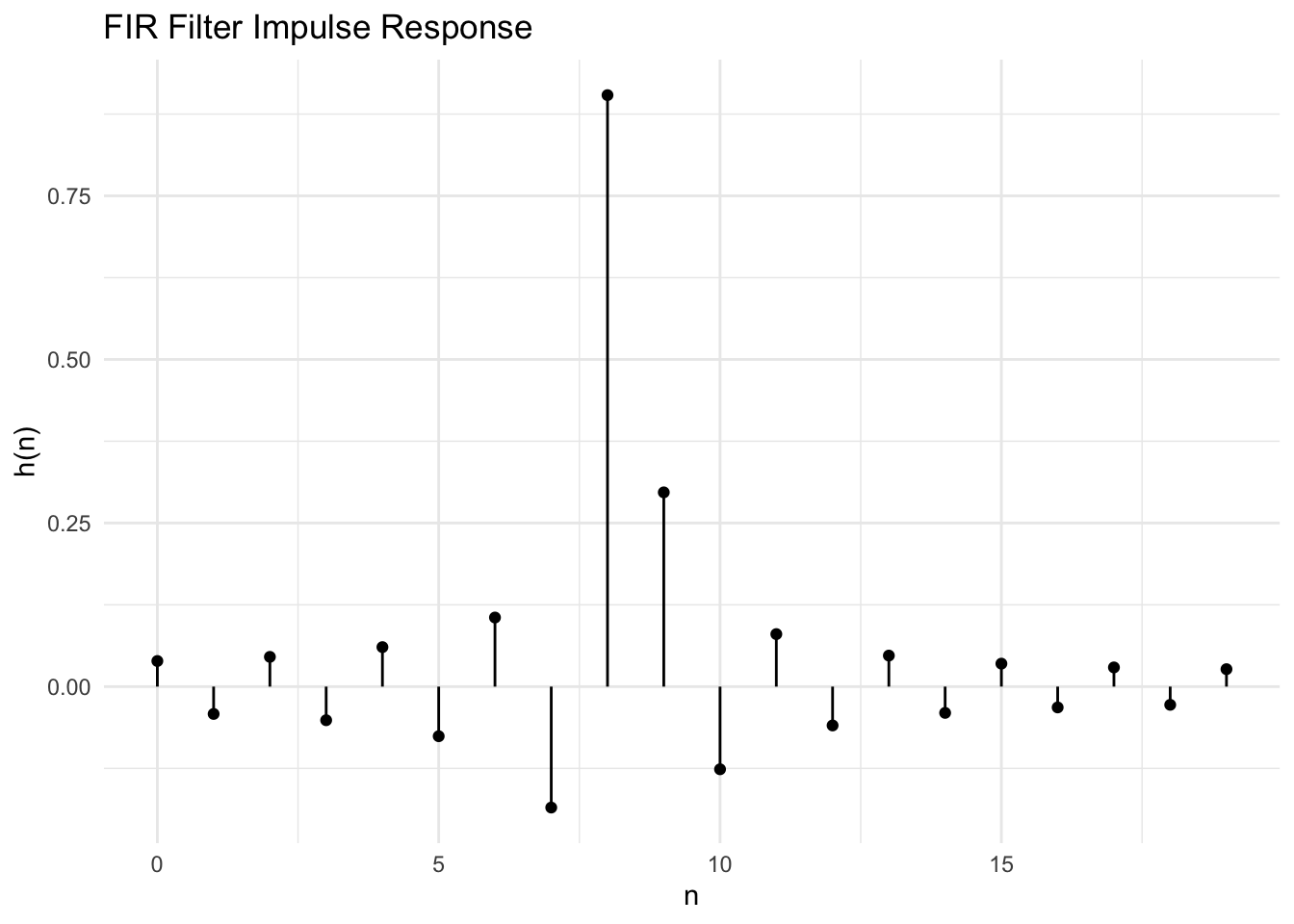
## Compute the frequency response
H <- as.vector(A %*% h_val)

df_mag <- data.frame(
    omega = rep(w, 2),
    magnitude = c(20 * log10(Mod(H)), 20 * log10(Mod(Hdes))),
    type = rep(c("Optimized", "Desired"), each = m)
)

ggplot(df_mag, aes(x = omega, y = magnitude, color = type, linetype = type)) +
    geom_line() +
    scale_linetype_manual(values = c("Desired" = "dashed", "Optimized" = "solid")) +
    coord_cartesian(xlim = c(0, pi), ylim = c(-30, 10)) +
    labs(x = expression(omega), y = expression(paste("|H(", omega, ")| in dB")),
         title = "FIR Filter Frequency Response Magnitude",
         color = "", linetype = "") +
    theme_minimal() +
    theme(legend.position = "bottom")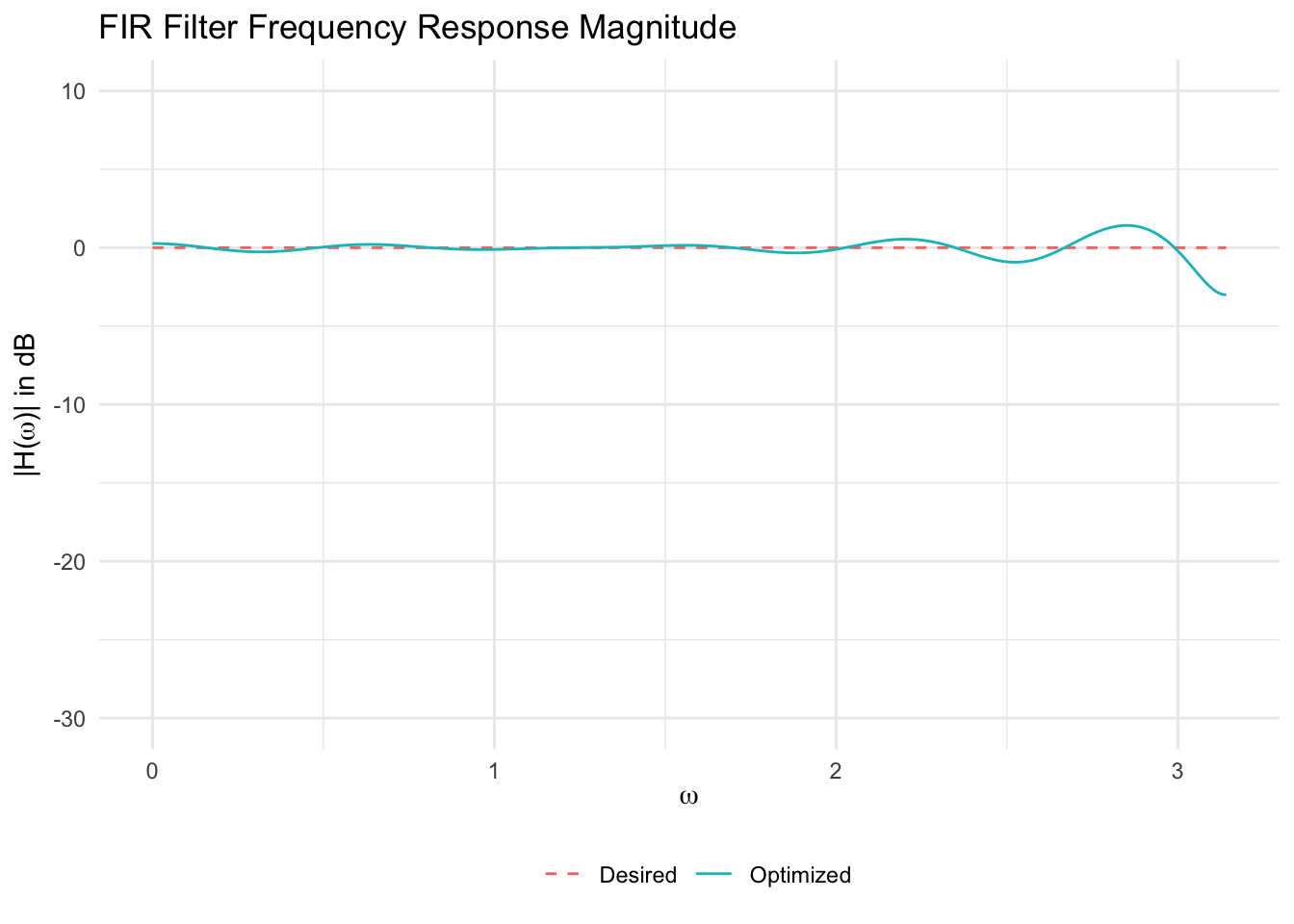
df_phase <- data.frame(omega = w, phase = Arg(H))

ggplot(df_phase, aes(x = omega, y = phase)) +
    geom_line() +
    coord_cartesian(xlim = c(0, pi), ylim = c(-pi, pi)) +
    labs(x = expression(omega), y = expression(paste(symbol("\xd0"), " H(", omega, ")")),
         title = "FIR Filter Frequency Response Phase") +
    theme_minimal()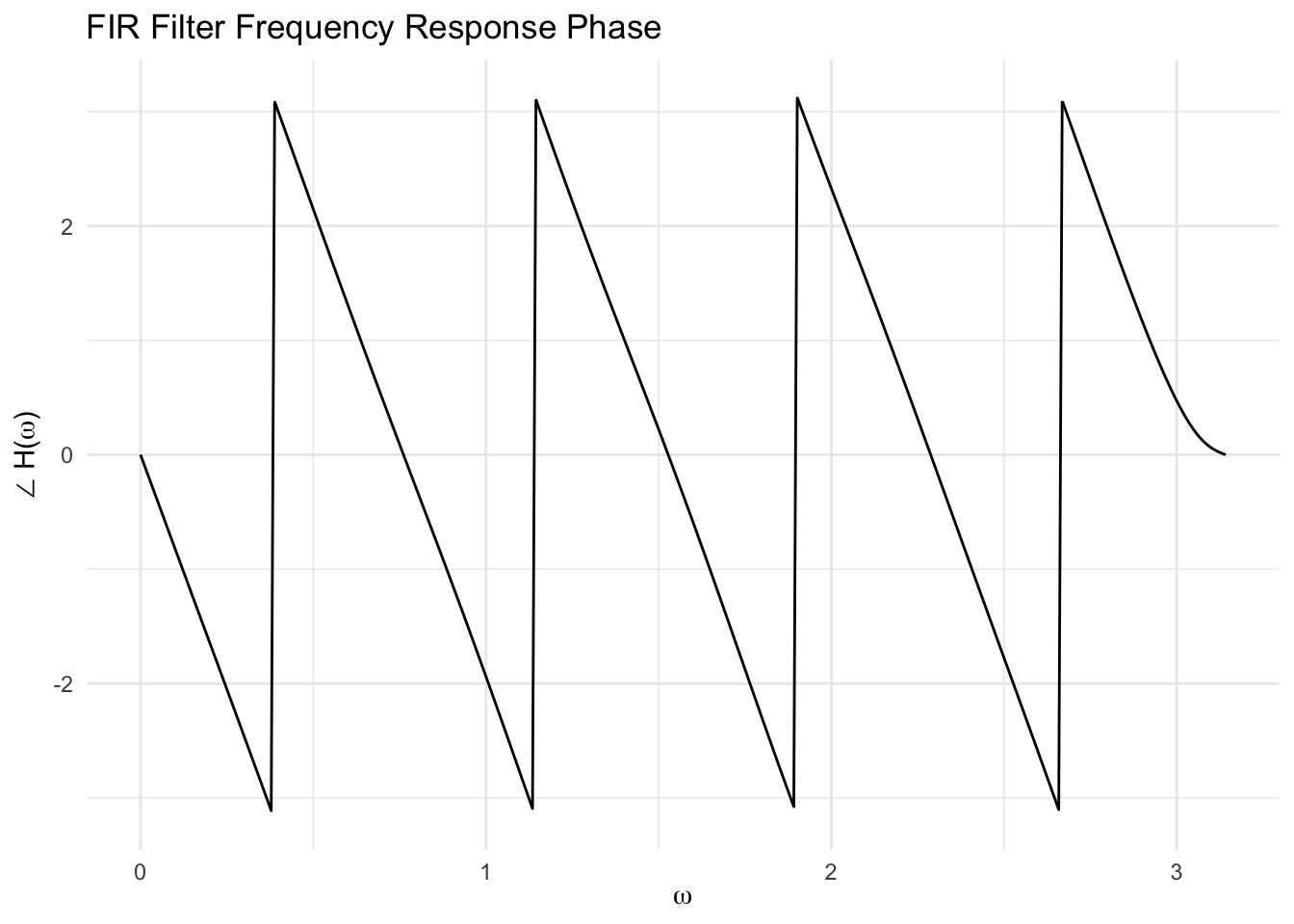
Session Info
R version 4.6.1 (2026-06-24)
Platform: aarch64-apple-darwin23
Running under: macOS Tahoe 26.6.2

Matrix products: default
BLAS:   /Library/Frameworks/R.framework/Versions/4.6/Resources/lib/libRblas.0.dylib
LAPACK: /Library/Frameworks/R.framework/Versions/4.6/Resources/lib/libRlapack.dylib;  LAPACK version 3.12.1

locale:
[1] en_US.UTF-8/en_US.UTF-8/en_US.UTF-8/C/en_US.UTF-8/en_US.UTF-8

time zone: America/Los_Angeles
tzcode source: internal

attached base packages:
[1] stats     graphics  grDevices utils     datasets  methods   base

other attached packages:
[1] ggplot2_4.0.3 CVXR_1.9.2

loaded via a namespace (and not attached):
 [1] piqp_0.6.2         Matrix_1.7-6       gtable_0.3.6       jsonlite_2.0.0
 [5] dplyr_1.2.1        compiler_4.6.1     highs_1.14.0-2     tidyselect_1.2.1
 [9] Rcpp_1.1.2         slam_0.1-56        cccp_0.3-3         dichromat_2.0-1
[13] scales_1.4.0       yaml_2.3.12        fastmap_1.2.0      clarabel_0.11.3
[17] lattice_0.23-1     R6_2.6.1           labeling_0.4.3     generics_0.1.4
[21] knitr_1.51         htmlwidgets_1.6.4  backports_1.5.1    checkmate_2.3.4
[25] tibble_3.3.1       osqp_1.0.0         pillar_1.11.1      RColorBrewer_1.1-3
[29] rlang_1.3.0        xfun_0.60          S7_0.2.2           otel_0.2.0
[33] cli_3.6.6          withr_3.0.3        magrittr_2.0.5     Rglpk_0.6-5.1
[37] digest_0.6.39      grid_4.6.1         gmp_0.7-5.1        lifecycle_1.0.5
[41] ECOSolveR_0.6.1    scs_3.2.7          vctrs_0.7.3        evaluate_1.0.5
[45] glue_1.8.1         farver_2.1.2       codetools_0.2-20   rmarkdown_2.31
[49] pkgconfig_2.0.3    tools_4.6.1        htmltools_0.5.9
References
- Boyd, S. “Filter design” lecture notes (EE364), Stanford University.
- Mutapcic, A. (2006). CVX example: Chebyshev design of an FIR filter.