Introduction
A grayscale image is represented as an \(m \times n\) matrix of intensities \(U^{\mathrm{orig}}\) (typically between the values \(0\) and \(255\) ). We are given the values \(U^{\mathrm{orig}}_{ij}\) , for \((i,j) \in \mathcal{K}\) , where \(\mathcal{K} \subset \{1,\ldots,m\} \times \{1,\ldots,n\}\) is the set of indices corresponding to known pixel values. Our job is to in-paint the image by guessing the missing pixel values, i.e., those with indices not in \(\mathcal{K}\) . The reconstructed image will be represented by \(U \in \mathbf{R}^{m \times n}\) , where \(U\) matches the known pixels, i.e., \(U_{ij} = U^{\mathrm{orig}}_{ij}\) for \((i,j) \in \mathcal{K}\) .
The reconstruction \(U\) is found by minimizing the total variation of \(U\) , subject to matching the known pixel values. We use the \(\ell_2\) total variation, defined as
\[
\mathop{\bf tv}(U) =
\sum_{i=1}^{m-1} \sum_{j=1}^{n-1}
\left\| \begin{pmatrix}
U_{i+1,j} - U_{ij} \\ U_{i,j+1} - U_{ij}
\end{pmatrix} \right\|_2.
\]
Note that the norm of the discretized gradient is not squared.
Grayscale In-Painting
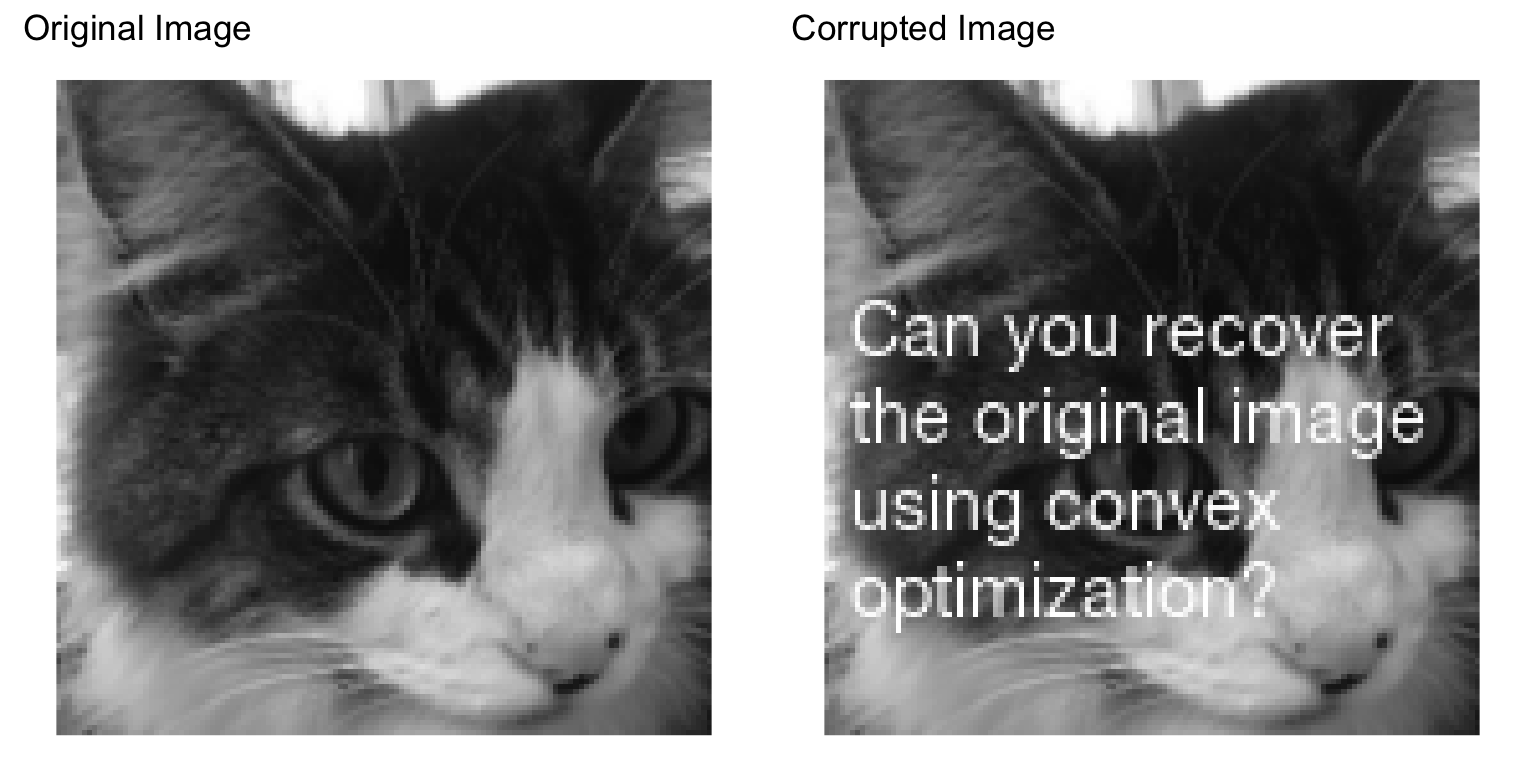
We load a \(128 \times 128\) grayscale image and a corrupted version where text has been overlaid on the original. The corrupted image has white text obscuring parts of the image. We construct the known matrix by comparing the two images: a pixel is known if it was not affected by the text overlay.
## Load the images <- readPNG (here:: here ("images" , "loki128.png" ))<- readPNG (here:: here ("images" , "loki128_corrupted.png" ))## If images are RGB, convert to grayscale by averaging channels if (length (dim (u_orig)) == 3 ) {<- (u_orig[, , 1 ] + u_orig[, , 2 ] + u_orig[, , 3 ]) / 3 if (length (dim (u_corr)) == 3 ) {<- (u_corr[, , 1 ] + u_corr[, , 2 ] + u_corr[, , 3 ]) / 3 <- nrow (u_orig)<- ncol (u_orig)## known is 1 if the pixel is known, 0 if corrupted <- 1 * (u_orig == u_corr)cat ("Image size:" , rows, "x" , cols, " \n " )cat ("Known pixels:" , sum (known), "out of" , rows * cols,sprintf ("(%.0f%%) \n " , 100 * sum (known) / (rows * cols)))
Image size: 128 x 128
Known pixels: 14090 out of 16384 (86%)
<- ggplot () + annotation_raster (matrix (gray (u_orig), rows, cols),xmin = 0 , xmax = 1 , ymin = 0 , ymax = 1 ,interpolate = FALSE ) + coord_fixed () + theme_void () + ggtitle ("Original Image" )<- ggplot () + annotation_raster (matrix (gray (u_corr), rows, cols),xmin = 0 , xmax = 1 , ymin = 0 , ymax = 1 ,interpolate = FALSE ) + coord_fixed () + theme_void () + ggtitle ("Corrupted Image" )grid.arrange (p1, p2, ncol = 2 )
Now we solve the total variation in-painting problem using CVXR. We use the SCS solver, which scales well to larger problems.
<- Variable (c (rows, cols))<- Minimize (total_variation (U))<- list (known * U == known * u_corr)<- Problem (obj, constraints)<- psolve (prob, solver = "SCS" , verbose = TRUE )
────────────────────────────────── CVXR v1.9.2 ─────────────────────────────────
ℹ Problem: 1 variable, 1 constraint (DCP)
ℹ Compilation: "SCS" via CVXR::Dcp2Cone -> CVXR::CvxAttr2Constr -> CVXR::ConeMatrixStuffing -> CVXR::SCS_Solver
─────────────────────────────── Numerical solver ───────────────────────────────
------------------------------------------------------------------
           SCS v3.2.7 - Splitting Conic Solver
    (c) Brendan O'Donoghue, Stanford University, 2012
------------------------------------------------------------------
problem:  variables n: 32513, constraints m: 64771
cones:    z: primal zero / dual free vars: 16384
      q: soc vars: 48387, qsize: 16129
settings: eps_abs: 1.0e-05, eps_rel: 1.0e-05, eps_infeas: 1.0e-07
      alpha: 1.50, scale: 1.00e-01, adaptive_scale: 1
      max_iters: 100000, normalize: 1, rho_x: 1.00e-06
      acceleration_lookback: 10, acceleration_interval: 10
lin-sys:  sparse-direct-amd-qdldl
      nnz(A): 94735, nnz(P): 0
------------------------------------------------------------------
 iter | pri res | dua res |   gap   |   obj   |  scale  | time (s)
------------------------------------------------------------------
     0| 2.55e+01  1.00e+00  4.12e+05 -2.06e+05  1.00e-01  2.51e-02
   250| 3.27e-02  6.77e-03  5.64e-03  7.14e+02  3.21e-01  3.86e-01
   500| 6.51e-03  6.90e-04  2.42e-04  7.39e+02  3.21e-01  7.43e-01
   750| 3.92e-03  2.47e-04  1.35e-04  7.40e+02  3.21e-01  1.09e+00
  1000| 2.92e-03  1.08e-04  1.19e-05  7.40e+02  3.21e-01  1.44e+00
  1250| 1.63e-03  3.57e-04  1.62e-05  7.40e+02  1.02e+00  1.79e+00
  1500| 1.95e-01  1.56e-01  3.23e-06  7.40e+02  1.02e+00  2.15e+00
  1750| 3.21e-04  7.93e-05  3.16e-06  7.40e+02  1.02e+00  2.50e+00
  2000| 2.51e-04  1.59e-04  2.21e-06  7.40e+02  1.02e+00  2.85e+00
  2250| 2.16e-04  3.93e-05  1.88e-06  7.40e+02  1.02e+00  3.20e+00
  2500| 1.56e-04  3.28e-05  1.52e-06  7.40e+02  1.02e+00  3.55e+00
  2750| 1.11e-04  1.35e-05  9.86e-08  7.40e+02  3.24e+00  3.90e+00
  3000| 7.84e-05  3.41e-06  6.78e-07  7.40e+02  3.24e+00  4.25e+00
  3250| 4.23e-05  1.62e-05  1.09e-06  7.40e+02  1.04e+01  4.61e+00
  3500| 3.09e-05  5.40e-05  4.80e-07  7.40e+02  1.04e+01  4.96e+00
  3725| 1.80e-05  4.36e-06  2.77e-07  7.40e+02  1.04e+01  5.27e+00
------------------------------------------------------------------
status:  solved
timings: total: 5.27e+00s = setup: 2.22e-02s + solve: 5.24e+00s
     lin-sys: 3.57e+00s, cones: 5.55e-01s, accel: 3.71e-01s
------------------------------------------------------------------
objective = 740.137245
------------------------------------------------------------------
──────────────────────────────────── Summary ───────────────────────────────────
check_solver_status (prob)cat ("Optimal objective value:" , result, " \n " )
Optimal objective value: 740.1374
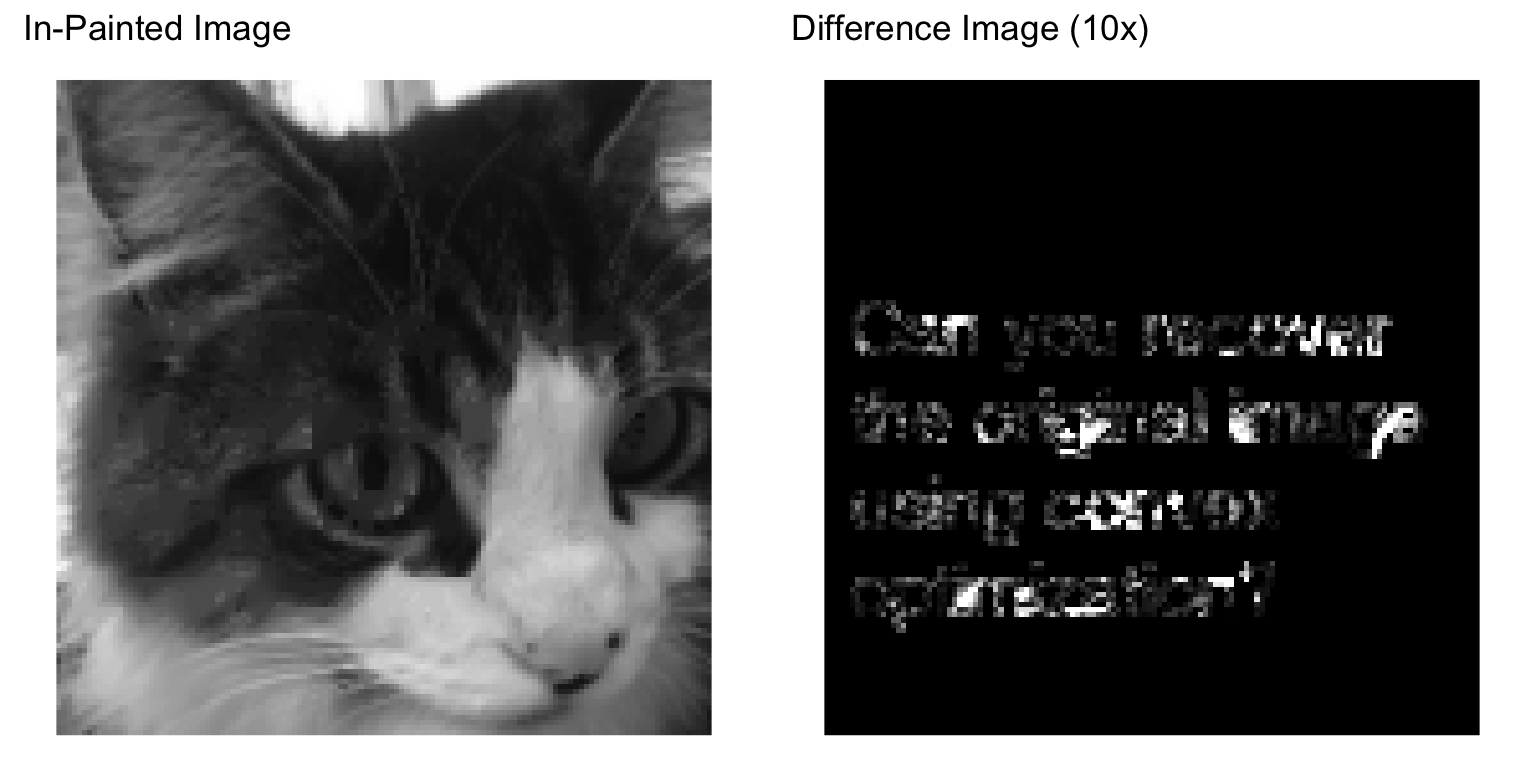
After solving the problem, the in-painted image is stored in the value of U. We display the in-painted image and the intensity difference between the original and in-painted images (magnified by a factor of 10 for visibility).
<- pmin (pmax (value (U), 0 ), 1 )<- ggplot () + annotation_raster (matrix (gray (U_val), rows, cols),xmin = 0 , xmax = 1 , ymin = 0 , ymax = 1 ,interpolate = FALSE ) + coord_fixed () + theme_void () + ggtitle ("In-Painted Image" )<- pmin (10 * abs (u_orig - U_val), 1 )<- ggplot () + annotation_raster (matrix (gray (img_diff), rows, cols),xmin = 0 , xmax = 1 , ymin = 0 , ymax = 1 ,interpolate = FALSE ) + coord_fixed () + theme_void () + ggtitle ("Difference Image (10x)" )grid.arrange (p3, p4, ncol = 2 )
Color In-Painting
For color images, the in-painting problem is similar to the grayscale case. A color image is represented as an \(m \times n \times 3\) array of RGB values \(U^{\mathrm{orig}}\) (typically between the values \(0\) and \(1\) ). We solve the problem by creating three CVXR variables (one per color channel) and minimizing the total variation jointly across all channels.
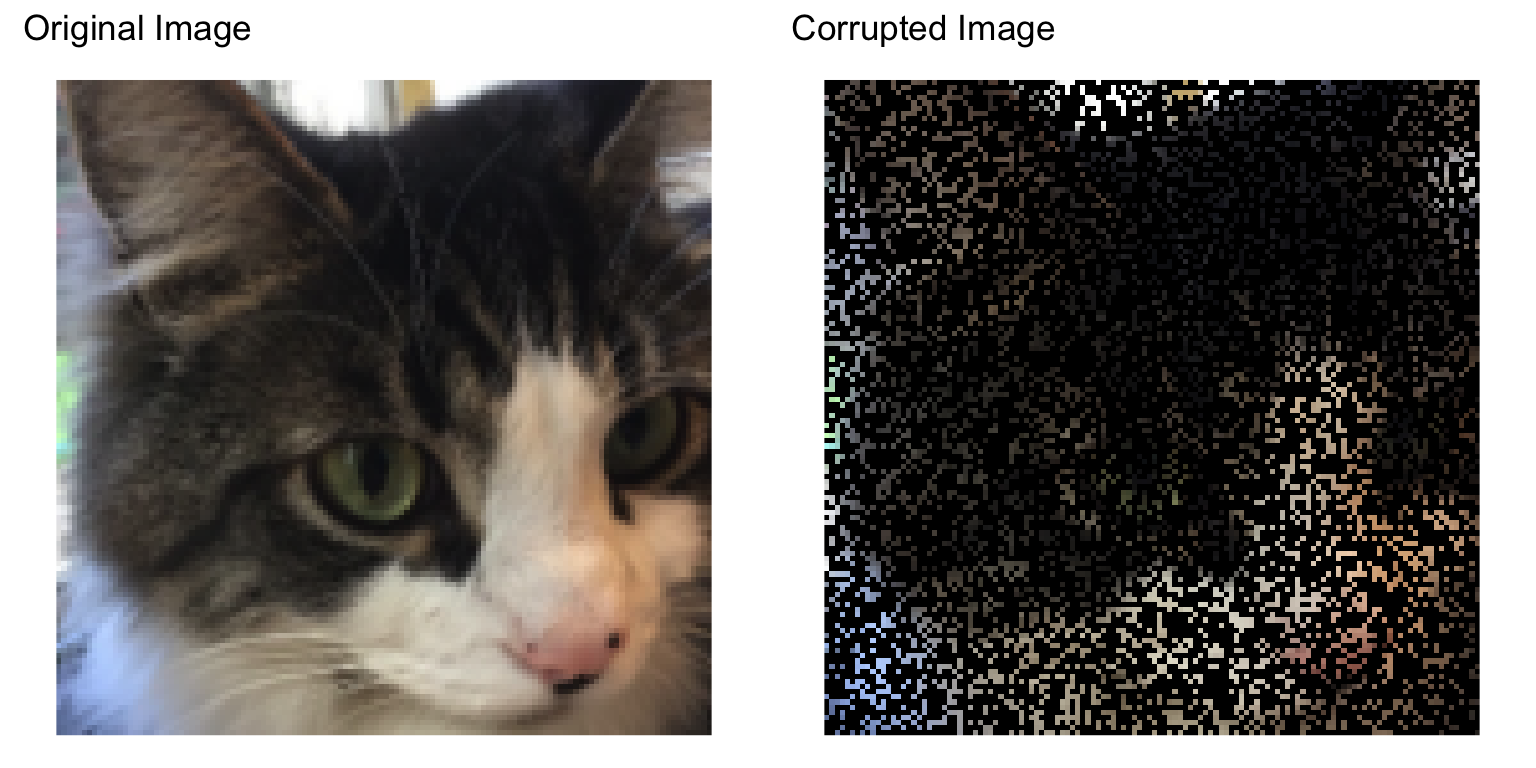
We load a \(128 \times 128\) color image and randomly discard \(70\%\) of the pixels.
set.seed (1 )## Load color image <- readPNG (here:: here ("images" , "loki128color.png" ))## Drop alpha channel if present if (dim (u_orig_color)[3 ] == 4 ) {<- u_orig_color[, , 1 : 3 ]<- dim (u_orig_color)[1 ]<- dim (u_orig_color)[2 ]<- dim (u_orig_color)[3 ]## known is 1 if the pixel is known, 0 if corrupted ## Randomly keep 30% of pixels <- matrix (as.numeric (runif (rows_c * cols_c) > 0.7 ), rows_c, cols_c)<- array (rep (pixel_mask, colors), dim = c (rows_c, cols_c, colors))<- known_color * u_orig_colorcat ("Color image size:" , rows_c, "x" , cols_c, "x" , colors, " \n " )
Color image size: 128 x 128 x 3
## Helper to convert array to raster string matrix for ggplot <- function (arr) {<- pmin (pmax (arr, 0 ), 1 )<- dim (arr)[1 ]; nc <- dim (arr)[2 ]matrix (rgb (arr[, , 1 ], arr[, , 2 ], arr[, , 3 ]), nr, nc)<- ggplot () + annotation_raster (arr_to_raster (u_orig_color),xmin = 0 , xmax = 1 , ymin = 0 , ymax = 1 ,interpolate = FALSE ) + coord_fixed () + theme_void () + ggtitle ("Original Image" )<- ggplot () + annotation_raster (arr_to_raster (u_corr_color),xmin = 0 , xmax = 1 , ymin = 0 , ymax = 1 ,interpolate = FALSE ) + coord_fixed () + theme_void () + ggtitle ("Corrupted Image" )grid.arrange (p5, p6, ncol = 2 )
## Solve the TV in-painting problem for each channel <- lapply (seq_len (colors), function (k) {<- Variable (c (rows_c, cols_c))<- known_color[, , k] * U_k == * u_corr_color[, , k]list (var = U_k, constr = constr)<- lapply (channels, ` [[ ` , "var" )<- lapply (channels, ` [[ ` , "constr" )<- Problem (Minimize (total_variation (variables[[1 ]], variables[[2 ]], variables[[3 ]])),<- psolve (prob_color, solver = "SCS" , verbose = TRUE )
────────────────────────────────── CVXR v1.9.2 ─────────────────────────────────
ℹ Problem: 3 variables, 3 constraints (DCP)
ℹ Compilation: "SCS" via CVXR::Dcp2Cone -> CVXR::CvxAttr2Constr -> CVXR::ConeMatrixStuffing -> CVXR::SCS_Solver
─────────────────────────────── Numerical solver ───────────────────────────────
------------------------------------------------------------------
           SCS v3.2.7 - Splitting Conic Solver
    (c) Brendan O'Donoghue, Stanford University, 2012
------------------------------------------------------------------
problem:  variables n: 65281, constraints m: 162055
cones:    z: primal zero / dual free vars: 49152
      q: soc vars: 112903, qsize: 16129
settings: eps_abs: 1.0e-05, eps_rel: 1.0e-05, eps_infeas: 1.0e-07
      alpha: 1.50, scale: 1.00e-01, adaptive_scale: 1
      max_iters: 100000, normalize: 1, rho_x: 1.00e-06
      acceleration_lookback: 10, acceleration_interval: 10
lin-sys:  sparse-direct-amd-qdldl
      nnz(A): 224494, nnz(P): 0
------------------------------------------------------------------
 iter | pri res | dua res |   gap   |   obj   |  scale  | time (s)
------------------------------------------------------------------
     0| 2.71e+01  1.00e+00  4.37e+05 -2.19e+05  1.00e-01  7.00e-02
   250| 3.34e-02  1.98e-03  1.94e-03  9.34e+02  1.00e-01  9.54e-01
   500| 8.33e-03  1.65e-03  4.92e-04  9.66e+02  3.18e-01  1.85e+00
   750| 4.66e-03  6.29e-04  1.33e-04  9.68e+02  3.18e-01  2.73e+00
  1000| 2.71e-03  2.52e-04  5.98e-05  9.68e+02  3.18e-01  3.62e+00
  1250| 1.80e-03  1.61e-04  3.14e-05  9.68e+02  3.18e-01  4.49e+00
  1500| 1.39e-03  5.40e-05  2.02e-05  9.68e+02  3.18e-01  5.36e+00
  1750| 9.97e-01  2.34e-01  3.11e-06  9.68e+02  3.18e-01  6.25e+00
  2000| 1.08e-03  1.76e-05  1.06e-05  9.68e+02  3.18e-01  7.12e+00
  2250| 9.94e-04  2.37e-05  8.22e-06  9.68e+02  3.18e-01  7.99e+00
  2500| 4.84e-04  4.95e-05  9.87e-06  9.68e+02  1.01e+00  8.89e+00
  2750| 4.17e-04  5.81e-05  4.91e-06  9.68e+02  1.01e+00  9.76e+00
  3000| 2.31e-04  4.41e-05  2.52e-06  9.68e+02  1.01e+00  1.07e+01
  3250| 1.62e-04  9.13e-06  1.50e-06  9.68e+02  1.01e+00  1.15e+01
  3500| 1.51e-04  3.54e-05  6.61e-07  9.68e+02  1.01e+00  1.24e+01
  3750| 2.33e-01  1.74e-01  1.99e-06  9.68e+02  1.01e+00  1.33e+01
  4000| 5.44e-05  8.89e-05  7.96e-07  9.68e+02  1.05e+01  1.42e+01
  4250| 3.76e-05  9.43e-06  1.11e-06  9.68e+02  1.05e+01  1.51e+01
  4350| 1.76e-05  7.45e-06  1.49e-06  9.68e+02  1.05e+01  1.54e+01
------------------------------------------------------------------
status:  solved
timings: total: 1.54e+01s = setup: 6.27e-02s + solve: 1.53e+01s
     lin-sys: 1.11e+01s, cones: 1.21e+00s, accel: 9.94e-01s
------------------------------------------------------------------
objective = 968.179787
------------------------------------------------------------------
──────────────────────────────────── Summary ───────────────────────────────────
check_solver_status (prob_color)cat ("Optimal objective value:" , result_color, " \n " )
Optimal objective value: 968.1805
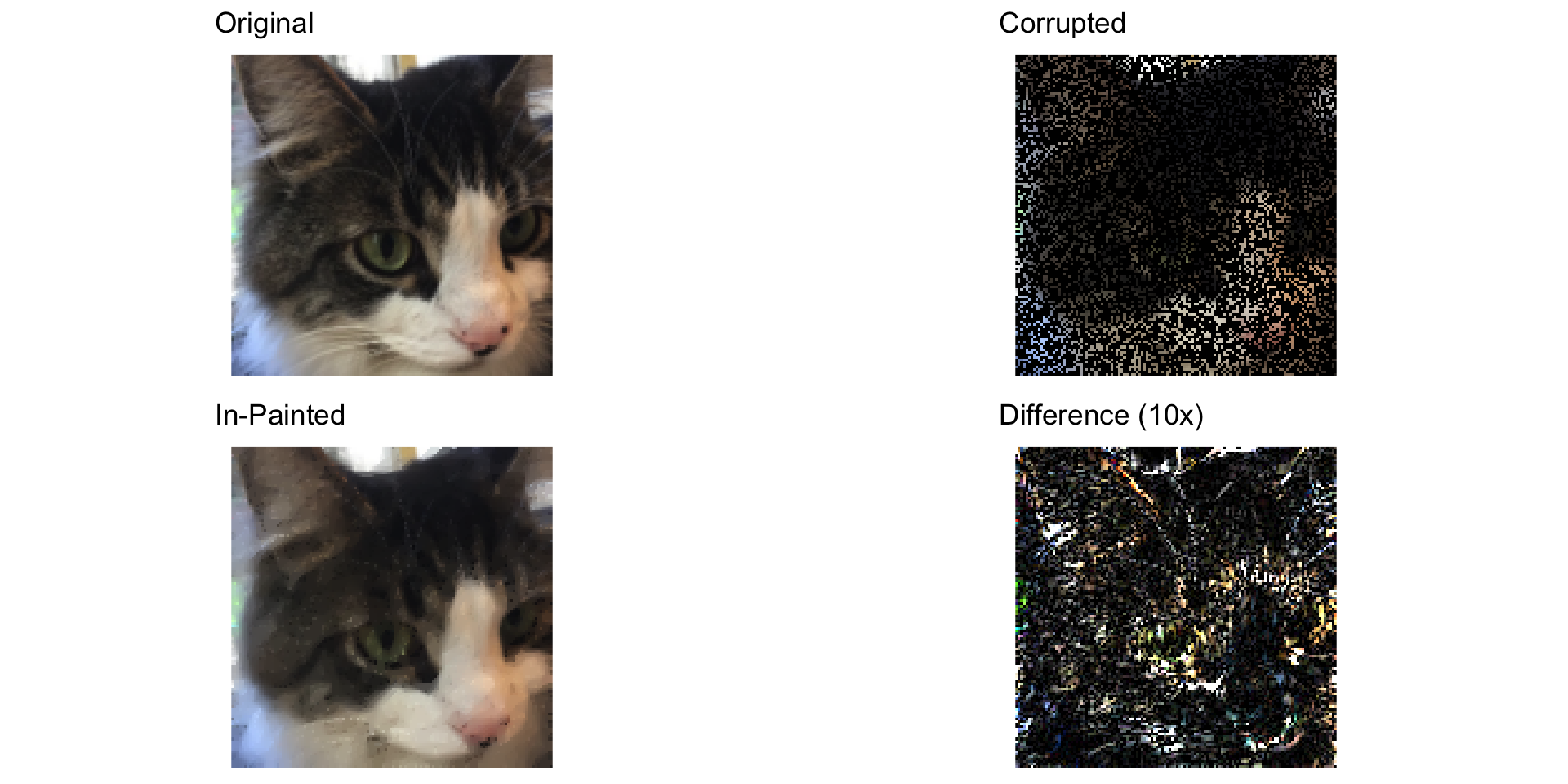
After solving, we reconstruct the color image and compare with the original.
<- array (unlist (lapply (variables, function (v) pmin (pmax (value (v), 0 ), 1 ))),dim = c (rows_c, cols_c, colors)<- ggplot () + annotation_raster (arr_to_raster (u_orig_color),xmin = 0 , xmax = 1 , ymin = 0 , ymax = 1 ,interpolate = FALSE ) + coord_fixed () + theme_void () + ggtitle ("Original" )<- ggplot () + annotation_raster (arr_to_raster (u_corr_color),xmin = 0 , xmax = 1 , ymin = 0 , ymax = 1 ,interpolate = FALSE ) + coord_fixed () + theme_void () + ggtitle ("Corrupted" )<- ggplot () + annotation_raster (arr_to_raster (rec_arr),xmin = 0 , xmax = 1 , ymin = 0 , ymax = 1 ,interpolate = FALSE ) + coord_fixed () + theme_void () + ggtitle ("In-Painted" )<- pmin (10 * abs (u_orig_color - rec_arr), 1 )<- ggplot () + annotation_raster (arr_to_raster (diff_arr),xmin = 0 , xmax = 1 , ymin = 0 , ymax = 1 ,interpolate = FALSE ) + coord_fixed () + theme_void () + ggtitle ("Difference (10x)" )grid.arrange (p7, p8, p9, p10, ncol = 2 )
Session Info
R version 4.6.1 (2026-06-24)
Platform: aarch64-apple-darwin23
Running under: macOS Tahoe 26.6.2

Matrix products: default
BLAS:   /Library/Frameworks/R.framework/Versions/4.6/Resources/lib/libRblas.0.dylib
LAPACK: /Library/Frameworks/R.framework/Versions/4.6/Resources/lib/libRlapack.dylib;  LAPACK version 3.12.1

locale:
[1] en_US.UTF-8/en_US.UTF-8/en_US.UTF-8/C/en_US.UTF-8/en_US.UTF-8

time zone: America/Los_Angeles
tzcode source: internal

attached base packages:
[1] grid      stats     graphics  grDevices utils     datasets  methods
[8] base

other attached packages:
[1] gridExtra_2.3.1 ggplot2_4.0.3   png_0.1-9       CVXR_1.9.2

loaded via a namespace (and not attached):
 [1] Matrix_1.7-6       gtable_0.3.6       jsonlite_2.0.0     dplyr_1.2.1
 [5] compiler_4.6.1     highs_1.14.0-2     tidyselect_1.2.1   Rcpp_1.1.2
 [9] dichromat_2.0-1    scales_1.4.0       yaml_2.3.12        fastmap_1.2.0
[13] clarabel_0.11.3    here_1.0.2         lattice_0.23-1     R6_2.6.1
[17] generics_0.1.4     knitr_1.51         htmlwidgets_1.6.4  backports_1.5.1
[21] tibble_3.3.1       checkmate_2.3.4    rprojroot_2.1.1    osqp_1.0.0
[25] pillar_1.11.1      RColorBrewer_1.1-3 rlang_1.3.0        xfun_0.60
[29] S7_0.2.2           otel_0.2.0         cli_3.6.6          withr_3.0.3
[33] magrittr_2.0.5     digest_0.6.39      gmp_0.7-5.1        lifecycle_1.0.5
[37] scs_3.2.7          vctrs_0.7.3        evaluate_1.0.5     glue_1.8.1
[41] farver_2.1.2       rmarkdown_2.31     pkgconfig_2.0.3    tools_4.6.1
[45] htmltools_0.5.9